The Best Digital Tools for Small Businesses in 2026: A Blueprint for Growth
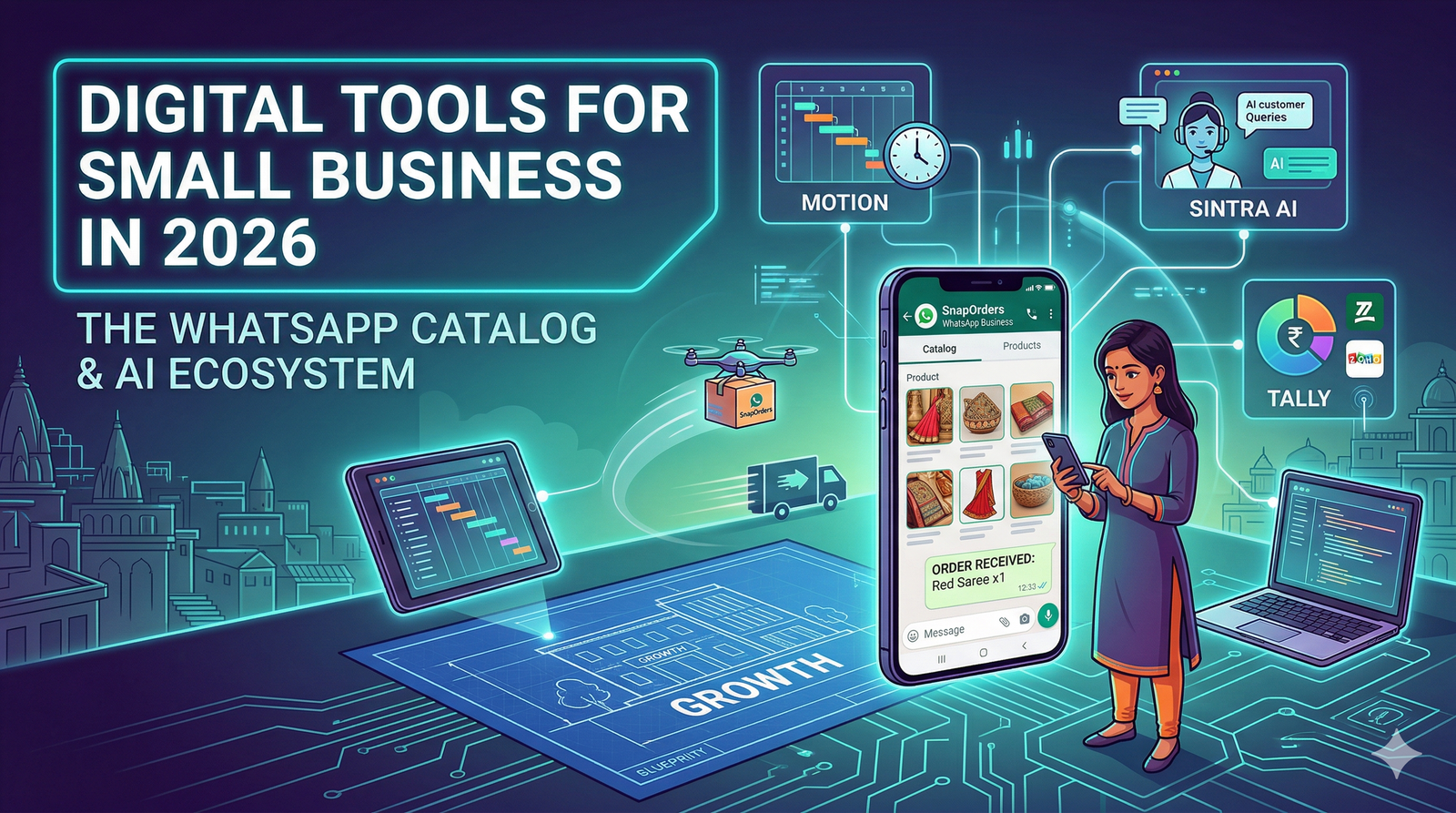
Digital tools for small businesses in 2026 focus on "Actionable AI" and seamless platform integration rather than isolated software. Modern SMEs are replacing fragmented apps with unified ecosystems that automate customer service, streamline logistics, and use predictive analytics to drive revenue. Success now requires tools that offer hyper-personalization and low-barrier entry points like social commerce.
Quick Glance: 2026 Digital Essentials
| Category | Top Recommended Tool | Primary Benefit |
| Sales & Cataloging | SnapOrders.in | Replaces websites with WhatsApp-based structured ordering. |
| Operational AI | Sintra AI | Deploys specialized AI agents for social media and support. |
| Workflow & Scheduling | Motion | AI-driven time blocking that builds your calendar automatically. |
Why are standalone websites losing to mobile-first catalogs in 2026?
Mobile-first catalogs, particularly those integrated with WhatsApp, convert 3x better than traditional websites by reducing friction in the buyer’s journey. In 2026, customers demand "Conversational Commerce" where they can browse, inquire, and pay within a single chat interface. This shift eliminates the need for complex navigation and reduces drop-off rates significantly for wholesalers and retailers.
The "death of the URL" for small businesses is driven by structured lead capture. While a website is a passive storefront, a digital catalog on a platform like SnapOrders is an active sales agent. For instance, a textile boutique in Varanasi recently reported a 40% increase in repeat orders after moving their 500-SKU inventory from a slow-loading website to a SnapOrders WhatsApp catalog. They moved from chasing "site visits" to managing "direct orders."
How does "Agentic AI" change small business productivity?
Agentic AI tools go beyond simple chat by executing multi-step workflows like drafting invoices, scheduling social content, and managing customer follow-ups autonomously. Unlike the basic bots of 2024, 2026’s digital tools feature shared memory and brand context, allowing them to act as full-time virtual employees for marketing and operations.
We are seeing a massive adoption of tools like Sintra AI and Agentforce, which allow founders to delegate:
-
Customer Support: Resolving 70% of queries without human intervention.
-
Content Ops: Using semantic keyword optimization to rank in AI Overviews.
-
Data Management: Converting raw sales data into actionable insights for inventory planning.
By 2025, over 58% of small businesses had embedded generative AI into their daily operations, according to recent industry reports. This isn't just about "using AI"; it's about UCP (Unified Customer Profile) integration, where every tool in your stack knows exactly who your customer is.
What are the must-have efficiency tools for 2026?
The must-have tools for 2026 are those that solve the "toggle tax"—the time lost switching between different applications. Small businesses are prioritizing unified workspaces that combine project management, communication, and financial tracking into a single, high-speed interface to maximize "Deep Work" phases.
The 2026 Tech Stack for SMEs:
-
Project Management: ClickUp or Notion remains king for centralized documentation and task flow.
-
Financial Clarity: TrueProfit (for e-commerce) provides real-time net profit tracking, accounting for ad spend and shipping instantly.
-
Time Defense: Motion uses AI to reshuffle your schedule when a meeting runs over, ensuring your "Focus Time" is never lost.
-
Contracting: Juro uses AI to turn contract drafting and signing into a 5-minute collaborative workflow.
People Also Ask (FAQ)
Q: Is a website still necessary for a small business in 2026? A: While a domain adds credibility, the primary "transaction engine" has shifted to social commerce and WhatsApp catalogs. Most SMEs now use a simple landing page that directs users straight into a high-conversion chat or catalog environment.
Q: How much should a small business spend on digital tools? A: In 2026, a "Lean Stack" (Sales catalog + AI Agent + CRM) typically costs between $100–$250 per month. This replaces the need for at least one full-time administrative hire.
Q: What is "Vibe Coding" for small businesses? A: Vibe Coding refers to using natural language (plain English) to build custom internal tools or apps without writing a single line of code, using platforms like Lovable or Replit.
Q: How do I protect my business from AI-driven cyber threats? A: Use tools with built-in zero-trust architecture and ensure all team members use biometric multi-factor authentication (MFA). 2025 saw a 30% rise in SME cybersecurity budgets for a reason.
Q: Can I integrate SnapOrders with my existing accounting software? A: Yes, most modern catalog tools offer Webhook or Zapier integrations, allowing order data to flow directly into tools like Tally, QuickBooks, or Zoho Books.
Ready to Scale Your Business?
The era of complex, expensive IT setups is over. Success in 2026 is about being where your customers are—on their phones, in their chats, and in their pockets.
Your next step: Transition your product list into a high-performance digital catalog. Start your free trial at SnapOrders.in today and see why the most successful wholesalers in India have abandoned traditional websites for conversational commerce.